Best musical instruments for kids | Our top 7 picks for young musicians

It’s no secret that learning to play a musical instrument has numerous educational benefits for children, but how do you choose an instrument for your child to learn? In this article, Fiona*, from Learn Music Together will cover the top 7 musical instruments for kids.
But before we get there, what are the benefits of learning a musical instrument?
There are many! Learning a musical instrument is one of the few activities that involves both sides of the brain. A 5-year study by the University of Southern California found that musical instruction can accelerate brain development in children and enhance their learning skills.
Research has also shown that music helps kids improve their mathematical ability and achieve better results in tests.
Aside from the educational benefits, there are numerous other benefits of playing an instrument.
If you’ve ever played yourself, you’ll know that music requires skills such as patience and resilience. By giving your child an instrument, you are teaching them responsibility, whether that be in terms of practising or looking after something that is of value.
For kids who lack confidence music is an excellent way of boosting their self-esteem. It can also help children who are dyslexic or dyspraxic improve their coordination skills.
It’s also likely that your child’s concentration will significantly increase when they begin to learn an instrument.
Getting started with music
Music amongst preschoolers is more popular now than ever, for many of the reasons that I’ve mentioned above. Musical toys and instruments for babies are a fantastic way to introduce sounds and music to young children.

However, there’s a big difference between a music set for toddlers and musical instruments. So how do you choose the next step, when there are so many musical instruments for kids to learn.
Fear not, the next part of this article has plenty of information about musical instruments for kids, and how to choose one that’s right for your child.
Is there a right or wrong instrument for my child?
The obvious answer to this is no; anybody can learn whatever instrument they choose. However, you may like to consider a few things if you want to give guidance to your child when making this decision.
Top Musical instrument for Kids
The following list to the top 7 musical instruments for kids is in no particular order and serves only as a helpful guide.
Violin
The Suzuki method of violin teaching is one of the most successful ways for kids as young as preschool to start playing. Violins are now available in sizes as small as 1/16 and are one of the most affordable instruments initially. However, be warned should your child have a talent, full-size violins can be a substantial investment.
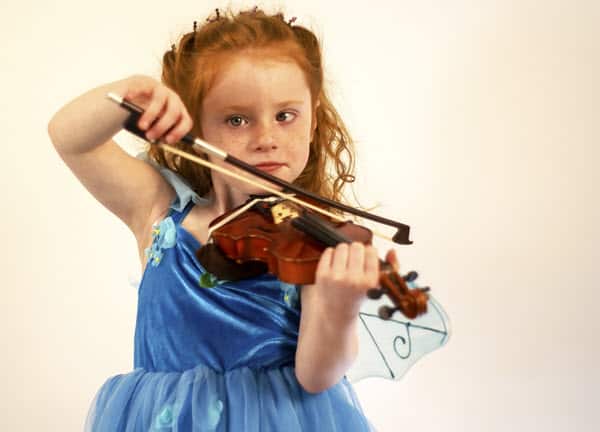
One of the philosophies behind the Suzuki Method is that young children from birth to approximately age 5 are especially attuned to sound. Hence it makes sense to develop their sensitivity to music during these age years as well.
The Suzuki Method is usually taught in groups, and parents are encouraged to be actively involved in the music practice at home. Of all musical instruments, the violin requires astute ear training. The hand position is responsible for the intonation, and the earlier a child starts developing their inner ear, the better.
That doesn’t mean to say that you can’t begin the violin at a later age. Reading music comes later in the Suzuki Method so that children can focus on developing their listening skills.
Piano
The piano is undoubtedly the most popular instrument for kids to learn. While children can start as early as 5, I would recommend starting a little later, unless they are super keen. The piano requires daily practice, and with two lines of music to learn, coordination can be challenging in the early stages.
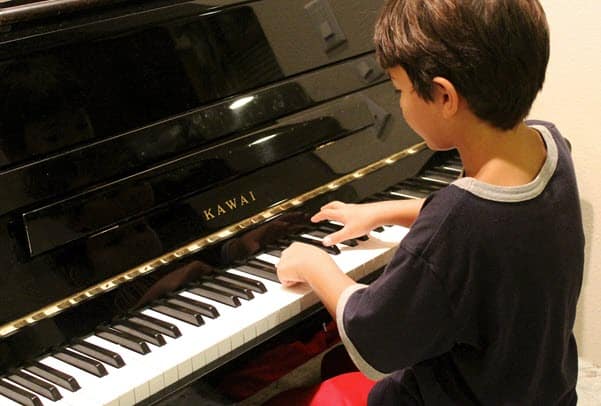
Like the violin, it’s advisable to supervise the practice, and I would encourage parents to sit in on the lessons, in the early stages, particularly if your child is starting at a young age. Pianos are of course a steep investment, and while there are excellent digital models available, they are not the same as an acoustic instrument.
Pianos have a hammer action, which is more weighted than a digital keyboard and controlling the production of sound is never completely replicated on electronic instruments.
Learning the piano gives an excellent foundation for music, and it’s a skill that will be invaluable should your child want to embark on a musical career. The piano teaches children to understand both harmony and melody which few other instruments do.
Guitar
Another popular instrument for kids to learn is the guitar. They are available in various sizes and are comparatively cheap compared with other instruments. While the guitar is not the easiest of instruments to play, strumming the hand across the strings is therapeutic and calming. This type of movement releases dopamine, which is a feel-good hormone.
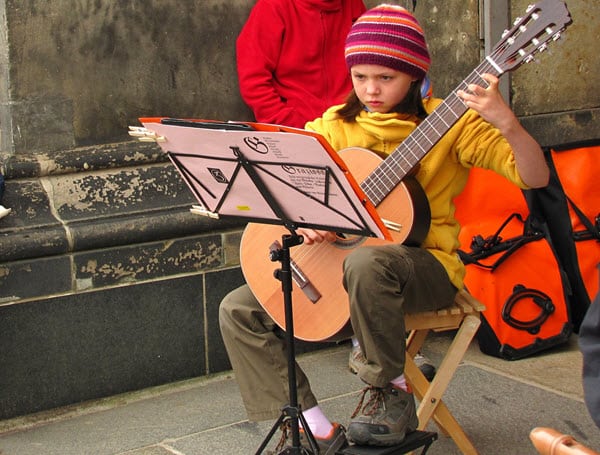
There are two approaches to learning the guitar, reading tabs or reading music. Guitar tabs are more approachable, to begin with, although if you want to take classical exams or join an ensemble, later on, it’s better to learn by reading music.
There is a vast range of styles that you can play on the guitar. The guitar nearly always features in a band, and there are plenty of soloists—however, it’s not used in orchestras.
Ukulele
The ukulele has seen a massive revival in recent years. It’s the smallest of all string instruments. Thus it’s a perfect option for a young person. The instrument is lightweight and easy to carry, making it an excellent choice to take to school.
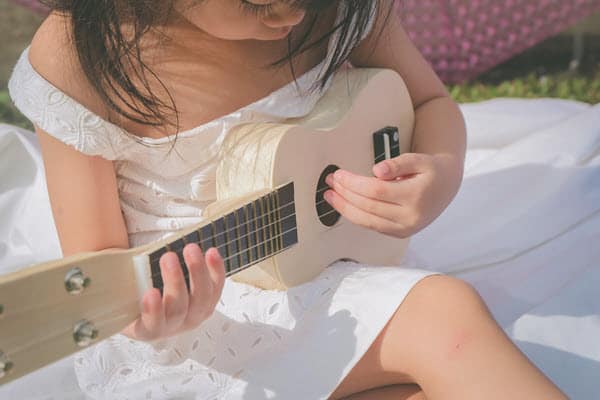
Kids ukuleles are widely available and inexpensive to purchase. The strings are easy to press, and the instrument can accompany a wide range of songs, from folk to contemporary. Children who start on the ukulele often progress onto other string instruments.
One of the downsides of the ukulele is that it’s not used in many ensembles, other than folk groups and ukulele bands. Playing in an ensemble has enormous benefits both socially and musically, so it is something to consider.
Drums
The drums are one of the best instruments to improve coordination as it involves all four limbs to work simultaneously. While the noise factor might put you off, a good drum teacher will soon teach your child how to play softly and control the tone.
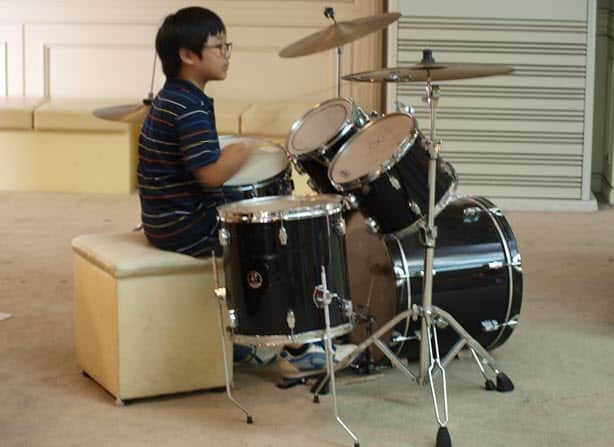
You can also get practice pads to cover the skins if you have concerns regarding the noise levels and your neighbours. Drum kits are reasonably cheap, and they are available in smaller sizes. However, invest in a ‘real kit’ as opposed to a kids drum set if you are serious about your child learning to play.
You can also purchase left-hand kits, but I’d speak to a teacher before investing. Left-handed players often learn the right-handed way for many reasons. Drummers have to have impeccable rhythm as they are the driving force behind all musical bands. While you don’t get drum kits in an orchestra, there is an opportunity to be involved in the percussion section.
Of course, drummers are an essential part of Jazz, Pop, Rock and Wind bands so there will be plenty of opportunities for a child to play in ensembles. However, each group usually has only one kit player.
Recorder
People often think of the recorder as a toy. However, some outstanding professionals would beg to differ. The instrument has an extensive range of repertoire, spanning more centuries than most others.

Whether you want to play baroque sonatas or contemporary classics, there will be a lot of choices. Of all instruments, the recorder is the cheapest, and you can easily purchase one for a few dollars. It is comfortable to blow and extremely lightweight.
Hence, it’s possibly one of the best musical instruments for kids to start learning.
They can pick up the basics of reading music, soon play songs that they know and many primary schools have recorder groups. Most recorder players then progress onto other woodwind instruments so that they can join wind bands and orchestras.
Harp
The harp is often not considered when choosing an instrument, yet the instrument features in many Disney films. I mention this as it’s a great source of inspiration for a child to see one of their favourite characters playing an instrument.
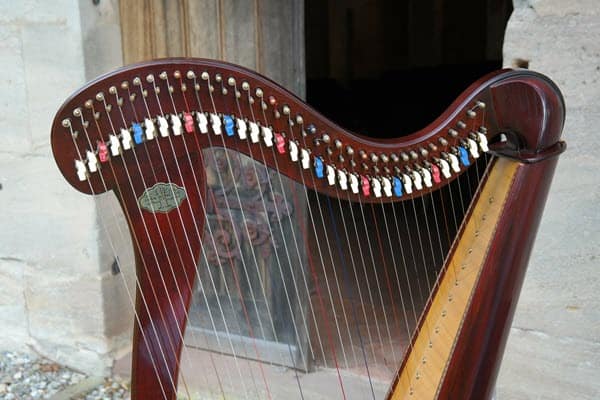
The harp is not the easiest of instruments; the number of strings requires patience and perseverance. However, it makes a beautiful sound that children and adults adore. Harps are available in many different shapes and sizes, so they are suitable for even small kids.
Understandably they aren’t the cheapest instruments to purchase, particularly later when they need a full-size instrument. Schools can often assist with this, but the price is something to consider.
Harps are an integral part of the orchestra, and the number of children learning to play is considerably less than other instruments. Hence, orchestras are always happy to have a harp player join them.
Other woodwind and brass instruments for kids
Until recent years it was not advisable to start learning to play instruments such as flutes, clarinets, trumpets and trombones until year 4 or 5. However, you can now buy smaller versions of these instruments which have made them more accessible.
One of the main things to consider is your child’s teeth. Woodwind and brass instruments rely upon the front teeth in some way to make a sound. Hence when your child loses their baby teeth at the front, this can cause problems.
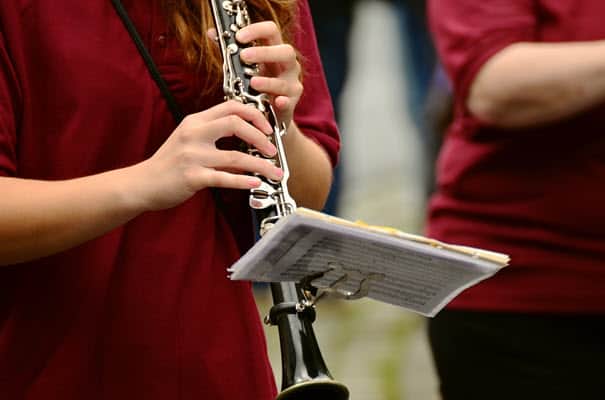
For this reason, I would advise that you defer learning a woodwind or brass instrument until they have their front adult teeth. There’s nothing more frustrating than getting off to a great start with an instrument, only to hindered a year or two later, with something that you can’t control.
Further considerations when choosing musical instruments for kids
Whatever instrument you or your child chooses, they will need your support. Progress relies upon a regular practice routine that, like homework, will require your support and involvement at home. Establishing a daily routine is the best way forward.
They’ll be times when your child doesn’t want to practice, and you will have to step in and motivate them. Reward charts and treats can help. To succeed at anything, children need the support of a parent or guardian.
Even if you are not musical, your child will benefit especially in the early years, if you sit with them, engage and listen while they practice. You could, of course, learn to play yourself at the same time.
How much should you spend on kids musical instruments?
Once you have decided which instrument your child wishes to learn, it’s always advisable to chat with a teacher before investing. While there are many cheap instruments on the market, they often don’t make the best investments.
You usually get what you pay for when buying an instrument, and trust me theirs nothing more frustrating than when an instrument is out of tune or not fit for purpose. Reputable brands vary between instruments. However, Yamaha is one of the best companies that produce a wide range of equipment.
Extra equipment
Whether it’s purchasing books, paying for tuition, replacing strings, reeds or other musical products, learning an instrument is an investment. While smaller instruments for children might be cheap, full-size instruments will cost more, even if you shop around.
However, music is a great gift and a skill that will bring your child great joy throughout their whole life, no matter what career path they choose.
I hope you’ve found this article on the 7 top musical instruments for kids helpful. If you have any questions, do get in touch.
* The guest writer behind this article is Fiona, a professional musician, and examiner for Trinity College London. Fiona has been involved in teaching children to play music for over twenty years and has travelled the world – including Australia- as an examiner. You can read more about her at Learn Music Together.