Best Sunscreen for Kids Australia (Top 7 Picks for 2026)

The fun of splashing in the pool, visiting a local playground, and lazy weekend BBQs can come with the stress of protecting your children from the sun’s harmful UV rays. Sunscreen is a must-have in most bathroom cabinets, but kid-friendly solutions are not easy to find.
Often we hear horror stories of severe reactions and sensitivities caused by sunscreen. This can make the task of application difficult for mums and dads, and some may avoid the process altogether. Which is why you should always do a patch test before use. Some kids sunscreens are just better than others!
In the following buyer’s guide, we’ll go over some of the best sunscreen for kids in Australia. The top of the bunch is the Aveeno Baby Screen due to the balance between what it does, how it does it, and what it costs.
But that is not to say that it will be best for everyone! (For example, I recently betrayed Aveeno and fell in love with another sunscreen. Won’t say which one, though!)
| IMAGE | PRODUCT | DETAILS |
|---|---|---|
Aveeno Baby Screen
|
||
La Roche-Posay Gel Lotion
|
||
Banana Boat Kids Roll On Sunscreen
|
Best Sunscreen for Kids in Australia
Best Overall — Aveeno Baby Sunscreen
Aveeno Baby Screen
Comes in an innovative stick and contains zinc oxide that has been derived from natural resources. It is a mild formula that is gentle on delicate and sensitive skin types.
The best sunscreen for babies with sensitive skin is the Aveeno Baby Continuous Protection Sensitive Skin Sunscreen. This product is a fan favourite and is the go-to sunscreen for many parents. Like the other top picks on this list, it has a high sun safety rating with SPF50 and broad-spectrum protection against both UVA and UVB rays.
It is comfortable for little ones as it applies smoothly to the skin, and there is no sticky residue left behind. Sweat and water-resistant for up to 80 minutes; this sunscreen can be applied to both the face and body. The Aveeno Baby range is recommended by pediatricians, making the Continuous Protection Sensitive Sunscreen a safe and gentle choice.
My youngest has eczema (especially in the summer, with all the sweat). But this sunscreen caused him no problems whatsoever.
The formula is mineral-based, and is free from common irritants including parabens and phthalates. Plus, the size is compact, making this ideal for travelling or storing in the glovebox of your car! While the stick has been designed for convenience, some shoppers have noted spreading with your fingers may still be required. This product is also available in other application methods, including a creamy sunscreen lotion.
And if you like the brand but have a toddler or older kid, they have that variety as well, and it’s equally good!
Cons: One person’s heaven is another person’s hell. In other words, I love that it’s small because I can bring it with me all the time. But my wallet would prefer it to be a bit bigger!
Best Broad Spectrum — La Roche-Posay Gel Lotion
La Roche-Posay Gel Lotion
Designed to protect from both UVB and UVA, this lotion is excellent for kids 6 months to 3 years.
When buying sunscreens, most of us only look for the SPF. But did you know that this factor only has to do with the so-called UVB rays, the ones that make your skin burn?
To ensure maximum protection, you should look for sunscreens that combine anti-UVB with anti-UVA. The latter are rays that reach deeply through the skin and cause damage that’s less painful but more long-lasting!
In fact, these UVA rays actually comprise the greatest part of UV radiation.
And that’s exactly where La Roche-Posay Gel Lotion is unique. It addresses both types of UV. It’s also absorbable, which makes it easy to spread on wet skin. However, I wouldn’t quite agree with the “non-oily” part that they advertise. To me, it did seem a bit oily! Thankfully, it will sink in pretty fast and won’t stain the clothes.
Cons: For many buyers, it will be on the pricier side.
Best Budget Pick — Banana Boat Kids Roll On Sunscreen
Banana Boat Roll On Sunscreen
This sunscreen formula is hypoallergenic and it comes in a convenient roll on. The bright packaging features popular cartoon characters, making it more appealing to young children.
You are probably familiar with the Banana Boat jingle, and whether you love it or hate it, their sunscreen is worth trying. The Banana Boat Kids Roll on Sunscreen is a convenient option, and this is why we have awarded it the title of best roll on sunscreen. Packaged in bright yellow and blue, you will always be able to find this product in your beach bag. The roll-on design means it is easy to apply, with no mess and no greasy residue.
The formula is long-lasting, and when applied generously and at least 20 minutes before commencing outdoor activities, you can expect the full benefits of the SPF 50+ protection. As a UVA / UVB broad-spectrum solution, you will get maximum coverage and up to 4 hours water resistance. However, you will need to reapply after 2 hours.
The brand promotes this as being hypoallergenic, and it is free from artificial fragrances. As a practical, quick solution that the whole family can use, The Banana Boat Kids Roll-on Sunscreen can be found in cars, backpacks, and bathrooms all around Australia.
Available in tube, pump, or spray design.
Cons: Not a big deal, but it does get stuck from time to time. When it happens, you’ll have to loosen it up manually.
Best for Sensitive Skin — Cancer Council Kids Sunscreen
Cancer Council Kids Sunscreen
A trusted name and their kid’s sunscreen has been tried and tested. The products are Australian made and are free from common irritants such as fragrance and parabens.
A terrifying name, isn’t it? But don’t worry – it’s called that because you’ll be supporting cancer research if you decide to buy this little tube.
But even without that, Cancer Council Kids Sunscreen Lotion is an awarded, high-quality solution with an affordable price tag. The formula has been specifically designed for use on delicate and sensitive skin and has been dermatologically tested. As this can be used from 6 months, it is an excellent choice for the whole family. Adults with sensitive skin will also benefit from this gentle product.
There are different application options available, and this kids sunscreen comes in a tube, roll on, or pump. The large pump is the most economical choice, but the tube will fit neatly in your day bag. SPF50+ is the current recommended standard for sunscreen, and this has both UVA and UVB protection.
Before venturing into the sun, apply generously, and wait approximately 20 minutes. Despite being water resistant for up to 4 hours, you do still need to reapply every 2 hours to maintain a high level of sun protection. When you purchase the Cancer Council Kids Sunscreen Lotion, a portion of the sale goes towards supporting cancer research in Australia.
A great thing is that it spreads pretty easily. No need to rub until your fingers go numb.
Cons: Since it’s thin, you might have to reapply frequently. And therefore, buy more often!
Best Sunscreen with Zinc — Ethical Zinc Natural Clear SPF 50 Sunscreen

Ethical Zinc SPF 50 Sunscreen
An ethical, Australian-made product built for kids and adults alike. Once applied, a natural barrier is created to give your child protection from the sun.
Zinc is iconic in Australia, but over recent years the coloured classic has been replaced by a more subtle version. The best sunscreen for kids in Australia that contains a natural zinc oxide shield is the Ethical Zinc Natural Clear SPF 50 Sunscreen. Unlike the neons that were swiped across our noses in previous decades, this dries clear!
But it’s not just about residue (or lack thereof). It’s also about the way in which it was made.
The manufacturer claims it’s an eco-friendly product, made using solar power only, and without hurting either animals or the ocean. It’s a very important concern for me and my family.
With 22% zinc oxide, plus 4 hours of water resistance, and UVA and UVB protection, Ethical Zinc has been formulated with the harsh Australian climate in mind.
Also, don’t let the name discourage you. It doesn’t say “kids” anywhere, but it’s still kid-friendly (as well as adult-friendly). In fact, it’s so gentle that it doesn’t burn the eyes at all.
Cons: The texture is a bit thick. Once it gets in touch with the warm skin, it becomes oily. Expect some sand sticking to your skin!
Best Roll-On — Sun Bum Baby SPF 50 Sunscreen
Sun Bum Baby SPF 50 Sunscreen
Gentle but powerful, plant-based formula that has a broad spectrum of protection and is easy to use.
If I could mix up the Ethical Zinc and La Roche-Posay products from above and squeeze them into a roll-on stick, I bet this Sun Bum Baby Sunscreen would come up as the result.
On the one hand, it doesn’t contain harsh chemicals. (Unlike so many other supposedly baby-friendly sunscreens, even some of the most popular ones!) Most of the ingredients are plant-based oils, waxes and butters. That makes it great for sensitive skin or particularly sensitive areas. Heck, it’s primarily intended for the face! But of course, can be used on the body too.
On the other hand, it contains almost 20% active zinc oxide, which is great for skin protection. Last but not least, it’s cruelty-free and vegan.
As for convenience of storage, carrying and use, the package speaks for itself.
Now, the price can seem a bit overwhelming for such a small product. But if you only use it on your baby and not the whole family, it should actually last relatively long.
Cons: It can leave some white residue on darker skin types.
Bonus: Best Applicator — Solar Buddies Refillable Roll On Sponge
Solar Buddies Refillable Roll On Sponge
A very clever invention for bigger kids who need to apply sunscreen on their own!
I get it: you’re only here for the sunscreens. And I only meant to write about them. But then I came across this Solar Buddies Refillable Roll On Sponge and it just blew me away! So I couldn’t help but include it on my list.
Many parents of very small kids won’t exactly get the purpose of this little tool. Why have them apply sunscreen on their own when you can do it? But if you’re mum or dad to a red-haired and freckled little schooler like I am, you’ll get my point. (Especially if you’re bigger on sunscreen lotions than roll-ons or sprays.)
The thing is, people with very light skin should always wear sunscreen, no matter the season. Especially in Australia! Now, it’s probably easier to realise why this applicator is a lifesaver. Thanks to the sponge and roller ball combo, even thicker lotions aren’t difficult to apply with it.
But this is not to say that you can’t use it with smaller kids too. Even though you are there to help them out, the feeling of doing it on their own will mean much for their early sense of independence!
Now, we haven’t had it for long enough, so I can’t attest to its durability.
Cons: A bit tricky to wash!
What to Consider When Buying Sunscreen for Kids in Australia
Safety
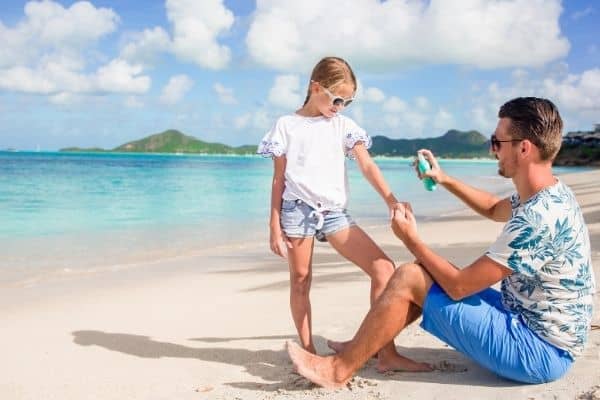
Children have sensitive skin, and it is important you use a sunscreen that meets strict Australian safety regulations. It should be dermatologically tested and free from fragrances and other harsh ingredients. Sunscreen should not be expired, and you should always do a patch test first before applying it over the entire body. Remember, babies under six months should not use sunscreen, and you should avoid exposure to direct sunlight whenever possible.
UVA (Ultraviolet A) rays are long wavelengths that can penetrate deep into the skin. UVA rays cause skin damage such as wrinkles and premature aging. UVB (Ultraviolet B) rays are shorter wavelengths and cause damage to the top layers of the skin. This can result in sunburn and skin cancer. The sunscreen you choose should be broad spectrum and offer protection against both of these UV ray types.
Sunscreen is not a solution that should be used on its own. It is only effective when applied according to the manufacturer’s instructions and reapplied as necessary. Other sun safety practices should be implemented, such as hats, sunglasses, shade, and long clothing.
Ingredients
Sometimes what isn’t included is more important than what is. Fragrances and parabens should be avoided as they can cause skin reactions. There is no definitive list of ingredients to avoid, as allergies can depend on the individual. This is why a skin patch test is so important.
However, it is suggested you avoid oxybenzone, octinoxate, retinyl palmitate, homosalate, and octocrylene. If you purchase sunscreen in Australia, rest assured there are strict safety standards and testing procedures in place.
Application Method
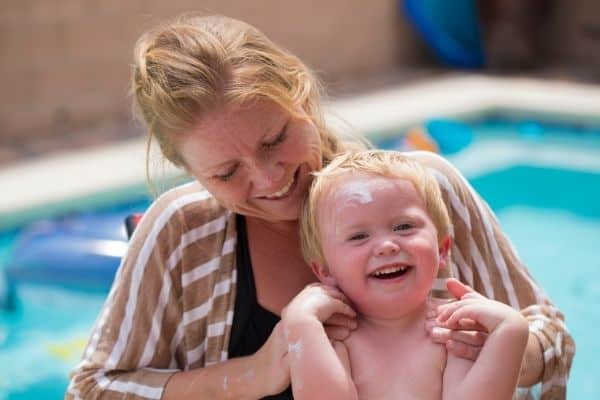
There are different methods of application, and the one you choose will be based on personal preference. Roll ons and creams are usually preferred by parents as they are easy to apply to wriggly toddlers.
Spray sunscreens are also available, but these can contain nanoparticles so only purchase from a reputable brand.
When applying sunscreen, you do need to use a generous amount, and don’t forget the ears, nose, and feet!
Frequently Asked Questions
Can my newborn baby wear sunscreen?
Sunscreen is not recommended for children under 6 months old. Instead, try to avoid direct sunlight and find a shaded area.
Other sun protection options for babies include a hat, long sleeves and pants in UV resistant material, and sunglasses.
What other sun protection does my child need?
It is recommended that all children and adults follow the “Slip, Slop, Slap, Seek, and Slide” mantra. This saying isn’t new but it has had two additions (seek and slide) since the first ad appeared back in 1981.
Sunscreen alone does not offer adequate protection and can still result in burns and skin damage. This is especially true for young children as they have delicate, fragile skin. Choose a shady spot to sit or play, and get the whole family in the habit of wearing wide-brimmed hats, sunglasses, and long clothing when outdoors.
What should I do if my child gets sunburnt?
If your child gets sunburnt, your response should depend on the severity of the damage. For extreme sunburn, you should consult with your doctor. If the sunburn is mild, ensure your child stays well hydrated. You can use a cool, damp towel to gently pat the area to provide comfort.
Aloe vera is known for its soothing properties, and if you are a green thumb, you may have the plant growing in your garden. Otherwise, look for products containing aloe vera that has been specifically designed for sunburns. Moisturisers can cause pain, so try to avoid them for a few days.
If you are looking for the most effective sunscreens for children, you are sure to find the right solution above. Remember, a water-resistant, broad-spectrum sunscreen that protects against UVA and UVB rays is recommended. Sun protection should be about more than just sunscreen, but an effective solution will help to minimise the risk of sunburn and long term damage.
Contributor Anna Wood is a freelance writer and mother of 3.