Best Telescope for Beginner Australia (Top 8 Picks for 2026)

If you’re new to astronomy and want to explore the wonders of the night sky, buying a telescope can be a little daunting. There’s so much technical information that you can quickly feel out of your depth. To help we’ve put together a selection of beginner-friendly telescopes that will get you started on exploring the universe. Our top pick is the Celestron AstroMaster 70AZ because it’s a good quality, user-friendly telescope, that is small enough to easily store and transport
| IMAGE | PRODUCT | DETAILS |
|---|---|---|
Celestron AstroMaster 70AZ
|
||
Celestron NexStar 130SLT
|
||
Celestron 71008 SkyMaster 25×70
|
Related post: Best Drones For Kids Australia
Best Beginner Telescope Australia
Our Top Pick — Celestron AstroMaster 70AZ
Celestron AstroMaster 70AZ
This telescope is ideal for viewing the night sky and for making land observations, it’s easy to use and has a good range.
The Celestron AstroMaster 70AZ is a nice and simple telescope. It’s a refractor scope so it looks exactly like you’d imagine a telescope should. The Alt-Az mount makes it easy to manipulate, and the red dot finderscope helps you locate the stars you’re looking for.
One of the challenges for amateur astronomers is knowing where to look to find celestial objects. This is why buying a Celestron telescope can be such a good choice. They all come with access to their software and app. The app has some great sky maps, which make it easy to locate objects of interest in the night sky.
When you combine the app with the easy-to-use Alt-Az mount, you can easily find planets, nebulae, and star clusters to view.
This telescope under 500 comes with everything you need to get started. There are two eyepieces, and a red dot finderscope included.
Best Computerized Telescope — Celestron NexStar 130SLT
Celestron NexStar 130SLT
This computerised telescope has a large aperture and makes finding objects in the night sky effortless.
The Celestron NexStar 130SLT is an excellent choice for enthusiastic beginners. It is a computerised telescope. This means that once calibrated you can tell it what you want to look at and it will automatically go to the right position. That’s why this type of mount is called a go-to mount.
For beginner astronomers, it doesn’t get any easier. The alignment process with this telescope is really simple. You first align the finder scope. Then you point your telescope at any three bright stars in the sky. You don’t need any prior knowledge or experience.
If you don’t know what to look at, this telescope can make recommendations of what will be good to look at based on the time and date.
This is a refractor telescope with a 70mm aperture. So even though it’s quite a compact telescope, it offers a superior image. You can easily view the craters on the moon, The clouds of Jupiter and even star clusters beyond the solar system.
Budget Option — Celestron 71008 SkyMaster 25×70
Celestron 71008 SkyMaster 25×70
The binoculars are designed specifically for astronomy. They offer a great value alternative to a telescope, that is ideal for beginners.
The Celestron 71008 SkyMaster 25×70 is a great pair of binoculars. Beginners to astronomy often overlook binoculars as an option, which is a great shame. They offer a great balance of aperture size and ease of use. With a good pair of binoculars, you will be able to see as much as you can with many telescopes.
These binoculars have an aperture size of 70mm. That makes them comparable with many of the other telescopes on this list. You won’t be sacrificing your range by opting for a pair of binoculars.
These binoculars are perfect for taking with you when you might want to do some stargazing. For how powerful they are, they are a good weight. However, if you do get tired, they have a tripod adapter with them so you can use them most tripods.
If the idea of a telescope is a little intimidating, which many people find, then binoculars are a great way to get into astronomy. The lower cost is another big bonus. Most experienced astronomers will have a pair of binoculars as well as their main telescopes, so no matter how much you get into astronomy, these will always come in handy.
Best Travel Telescope — Celestron 21035 Portable Refractor Telescope
Celestron 21035 Refractor Telescope
This 70mm refractor comes with a collapsible tripod and fits in its entirety into an included backpack for easy transport.
The Celestron 21035 Refractor Telescope is a really nice compact telescope. It is a refractor scope and has a 70mm aperture. This gives you some good quality images of objects inside the solar system. However, It does struggle a little with deep sky objects.
Where this telescope really shines in is portability. It comes with a great backpack that you can fit everything into. So if you want to be able to take a telescope out on a walk or camping, this is a great telescope.
Because this telescope is designed to be taken out and about, the tripod is collapsible. This does mean that it’s not the most robust tripod in the world, but it is sufficient for this light little telescope. You’d be well served to find good firm footing for it, however. This will help you to get the most out of this neat little telescope.
It comes with access to Celestron’s database and app, which will help you to find objects of interest whenever you get it out.
Best Compact Telescope — Meade Instruments Infinity 60
The Meade Instruments Infinity 60 is the smallest telescope on this list. Its aperture size is only 60mm. This means that you won’t be able to see many deep space objects. It is sufficient for viewing the moon and most of the planets in fair resolution.
This telescope is a basic easy to store option. If you are not sure about astronomy, or you want a telescope to only use on occasion, then this is a good choice. It is easy to set up and is sufficient for most casual observers.
This telescope is at a size and power that it can also double as a useful telescope for making land observations as well.
It comes with two eyepieces, a Barlow lens, a red dot finderscope, and a full-height aluminium tripod. The tripod is a little unstable if you don’t select the right spot to assemble it. So make sure to always pick as flat an area as possible. This will have a significant impact on your viewing experience.
Best Telescope with an EQ Mount — Meade Instruments 216004 Polaris 114
Meade Instruments 216004 Polaris 114
This is an excellent telescope for anyone who loves a challenge and wants to be able to track objects easily.
The Meade Instruments 216004 Polaris 114 is a telescope with a really good-sized aperture. At 114mm, you will be able to see all the objects of interest in the solar system as well as a large selection of deep-sky objects.
It’s a reflector scope which means that the eyepiece is located at the top of the barrel. When you combine this with the more intricate German EQ mount, it can appear a little intimidating to beginners. However, for some beginners this may offer the type of astronomy experience they’re looking for.
This is an ideal telescope for anyone who likes to challenge themselves. It takes a bit of work to use an EQ mount, but when you use it to correctly locate your chosen object, it is very satisfying. This particular EQ mount is well designed and offers really smooth motion. If you want to start with an EQ mount, then this is the one to try.
Best for Taking Pictures — Gskyer Astronomical
Gskyer Astronomical
This 70mm aperture telescope comes with a smartphone adapter and a wireless remote, it makes taking pictures of the night sky really easy.
The Gskyer Astronomical is a 70mm refractor telescope. It comes with an adjustable Alt-Az tripod mount as well as two eyepieces and a 3x Barlow lens. A Barlow lens is a nice addition for anyone interested in getting pictures, as it can easily be added to the existing eyepiece for a little extra magnification.
The fact that this telescope comes with a smartphone adapter is a very nice touch. It allows you to not only take pictures but also to share the viewing experience. If you have younger children, they may be more engaged looking at the larger phone screen instead of trying to use an eyepiece. Of course, the images will be much better if you view them directly.
This telescope comes with a handy carry case, which makes it nice and portable. It’s a good telescope to take out with you on adventures.
Best for Observing the Sun — National Geographic 76/350
National Geographic 76/350
This Newtonian reflector scope comes with a sun filter so you can safely make observations of our closest star.
When you think of astronomy, you think of looking at the star. Yet many novices forget that our sun is also a star. This is why it’s nice that the National Geographic 76/350 comes with a sun filter to allow you to safely observe the sun, as well as the night sky.
This telescope really delivers in terms of accessories. It comes with 2 eyepieces, a Barlow lens, and a universal smartphone mount. Unfortunately, it doesn’t come with a finderscope so it might be a good idea to consider buying one to go with it. It will make it easier to find night sky objects.
This is a reflector scope with an aperture size of 76mm. This will allow you to view a wide range of celestial objects, including planets, nebulae, and some star clusters.
What to Consider When Buying the Best Telescope for Beginner Australia
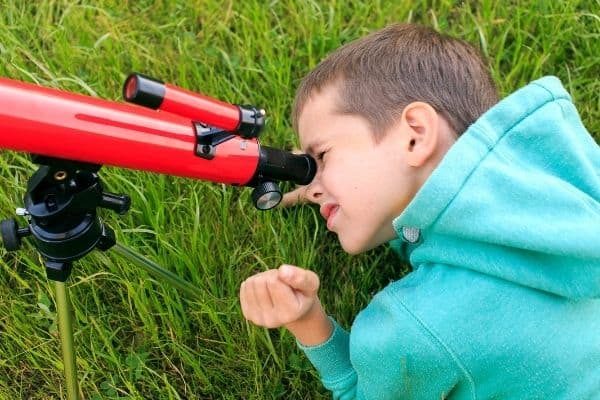
Aperture Size
Probably the most important feature of any telescope is the size of the aperture. The aperture is the name for the opening at the end of the telescope through which light enters. The larger the aperture, the more light your telescope will get. More light means that you will be able to see more objects in the night sky.
A telescope works by concentrating the light from the sky into a smaller space. It’s by doing this that you can see more. The aperture of your eye is very small, which is why you can’t see many stars. With a telescope, a larger amount of light is concentrated into the same space. This makes a dim object more visible.
Size and Weight
As the aperture of a telescope gets bigger, so does its length and weight. This is especially true with refractors. So while you might want a bigger aperture to see more, you need to keep an eye on the size of the scope. If it is too big, it can be difficult to move it to a viewing location.
If you will just be viewing from a single spot, this is less of an issue. However, if you will be travelling to viewing locations, then you’ll be better served by a more portable telescope. A pair of binoculars can actually be an excellent way to get started with astronomy as they are easy to carry around.
If you will be doing the majority of your viewing in an area with a lot of light pollution, you might want to consider a computerised mount. These can make it easier to track objects you might otherwise lose sight of.
Magnification
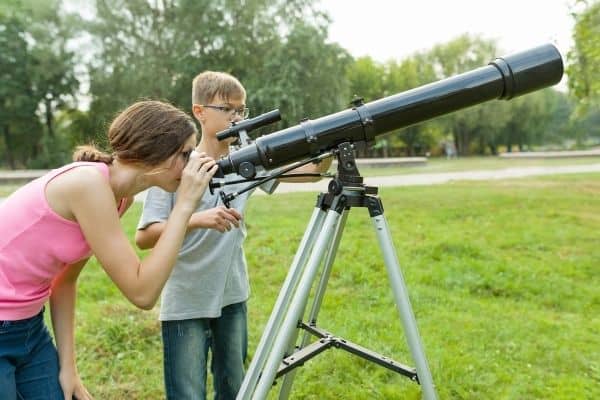
If you think that a better telescope is one with more magnification, then you’re not alone. It’s reasonable to think that you want a telescope that will magnify the night sky for you. However, if they aren’t taking in enough light to see objects, all you’d be doing is magnifying darkness. When it comes to image quality, you should be more interested in the aperture size.
It’s a warning sign if a telescope is being sold on the basis of its magnification. It usually means that it has a lot of other weaknesses.
For beginners, it can be better to opt for a telescope eyepiece that has a lower magnification. When the image is magnified, it is a lot more at the mercy of any small vibrations. Unless you are interested in looking at deep space objects, the magnification should not be of too much consequence.
The Mount
The telescope mount you choose is one of the most important factors to consider. There are three different types of mount to choose from.
Alt-Azimuth Mount (Alt-Az, AZ)
These mounts are the easiest to just pick up and use. They have two perpendicular axes. That means you can unjust them up and down or left and right. However, because of the way objects will move through the night sky, this can make it harder to track them.
Celestial objects will follow an arc across the sky, the same as the sun does during the day. So, to track an object through the night, you will need to adjust both axes simultaneously in order to keep the object in sight.
While tracking objects is a little more difficult, these scopes are easy to get started with.
Equatorial Mount (EQ)
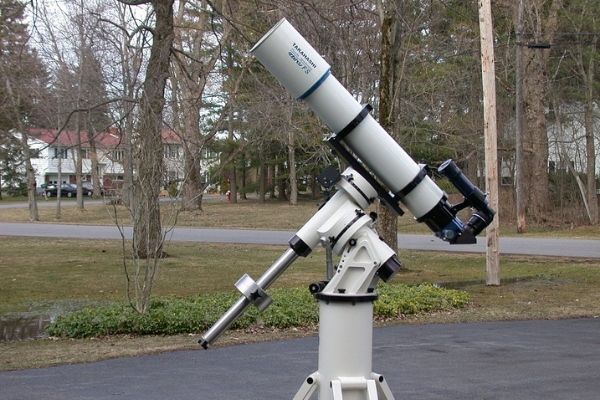
An equatorial mount is a more precise mount for making observations. The two axes are not perpendicular. They are configured to help you find objects based on their coordinates. One axis moves through declination, which is the angle from the celestial equator. The other axis follows an arc and moves through the right ascension.
Before you begin making observations, you have to align the mount with the pole star. You can then use the coordinates of the object you want, to find it easily. To track it, you just have to adjust the right ascension, which is much easier.
Learning to use an EQ mount requires more mathematical skills and a deeper understanding of what’s going on. It’s the right choice for someone with a deep interest in astronomy and astrophysics. It’s not the right choice for a casual observer.
Motorized Mounts
Motorised mounts can be either Alt-Az or Eq. Instead of moving them by hand, you use a handheld controller to move them. This reduces vibrations which is good for taking long exposure photos. These mounts can also be computerised. This means you can just select an object from a database. Once calibrated your mount will move to the right viewing position for you.
These are more expensive, but they are easy to use. You just need to be able to find and identify two bright stars in the night sky to calibrate the mount. They are also a more expensive option.
Type of Telescope

There are three main types of telescope. They each have different advantages and limitations.
Reflector
Reflectors use mirrors and not lenses like other types of telescope. This makes them much cheaper for the same aperture size. Because the light is reflected inside the telescope, they are often much shorter as well. This can make it easier to move them around.
Reflector scopes tend to be the same diameter from top to bottom. They often have the eyepiece near the top of the scope. This often allows for a more comfortable viewing position. But it can be disconcerting for beginners to not be looking towards the sky.
A Dobsonian telescope is a specific type of reflector telescope that’s good for beginners. It’s really easy to use and will give some great views of sky objects.
Refractor
These are the classic telescopes. If you are envisioning a long thin telescope with a big lens at one end and the eyepiece at the other, then you’re thinking of a refractor telescope. For a given aperture size, these will give you the best image. So if the size is a limiting factor for you, then a refractor telescope can be a good choice.
Refractors are easy to use, they’re durable, and they don’t need maintenance. You just need to store them properly, which is true for all telescopes. Because you are looking in the direction, you are facing they’re very intuitive for beginners.
On the downside, cheaper models can have some chromatic aberration. This means that the colour won’t stay true at the edge of the image.
Compound
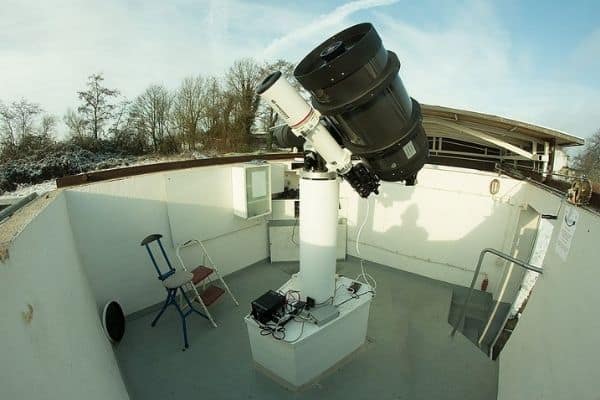
Compound or Catadioptric telescopes use a mix of reflection and refraction. There are loads of different types out there to choose from. The most popular are Schmidt-Cassegrains and Maksutov-Cassegrains. These scopes tend to be more expensive. You can find some good tabletop versions, which are a good option for kids just starting out.
Eyepiece
The eyepiece of your telescope is responsible for the magnification. The more magnification, the more detail you can see, as long as the image is bright enough. However, with larger magnification, you will also have a smaller field of vision.
For a beginner, I suggest looking for a scope with low magnification, to begin with. But, one that you can change the eyepieces on. This will allow you to play with the magnification once you’ve got the hang of finding objects in the night sky.
Frequently Asked Questions
What’s the best type of telescope for a beginner?
A Dobsonian telescope is a good option for beginners. They are easy to use, inexpensive, and more portable than some other scopes.

What type of telescope is best for viewing stars?
Most telescopes and decent binoculars will give you good views of the stars. The best option is one that you feel comfortable operating.
What’s the difference between a telescope, a spotting scope, and binoculars?
Telescopes are specifically designed for viewing the night sky. They only work for looking at celestial objects.
Spotting scopes are smaller telescopes. They can be held with one hand and can be used to look at the night sky as well as land-based objects.
A good pair of binoculars can be used for both day and night time observation. Binoculars can be a good option for beginners.