Best Bottle for Breastfed Baby Australia (Top 10 in 2026)

If you plan on bottle-feeding your baby, you might be surprised at how many different types of bottles there are to choose from. As baby bottles come in all shapes and sizes, parents can sometimes be confused about the best bottles for their baby.
Parents will quickly discover how using the wrong bottle can not only make feeding slower and less enjoyable but can result in problems like colic and reflux. To help make this process easier, we’ve done some research on the most popular bottles for newborns through to toddlers.
Our top pick is the best selling Philips Avent Natural Baby Bottles as its ultra-soft teat is designed to mimic the natural feel of the breast.
| IMAGE | PRODUCT | DETAILS |
|---|---|---|
Philips Avent Natural Baby Bottle
|
||

|
Minbie PPSU 0-6 Month Bundle
|
|
Medela Breastmilk Bottle
|
Best Bottles for Breastfed Babies Australia
1. Best Overall — Philips Avent Baby Bottles (2 Pack)
Philips Avent Natural Baby Bottle
This baby bottle can provide a comfortable and contented feed for your baby since it makes the transition from breast to bottle easy with its natural latch and wide breast-shaped teat.
When it comes to baby bottles, the Philips Avent Natural Bottles are a much-loved staple that has stood the test of time. Philips are renowned for producing high-quality products at affordable prices and their baby bottle range is no exception.
A consistent best-seller, these bottles come in a pack of two (either 125ml or 260ml) and are 100% BPA free. We like that they have wide teats to allow for a more natural latch, making the transition from breast to bottle easier for newborns.
Another plus is the inclusion of ‘slow flow teats’ to prevent newborns from gagging with milk that moves too quickly. The slow flow teats are a useful starting point on your bottle feeding journey.
Of course, faster flow teats are available and importantly, all teats are made from 100% soft silicone so they are BPA, phthalate and PVC free.
In an effort to assist with colic problems, all bottles have a valve design that vents the air away for maximum comfort while feeding. It’s not good when babies pick up painful wind from too much air consumption, so the inclusion of this valve is really handy.
We also like the shape and size of these bottles as they are easy to grasp in little hands.
It’s easy to see why the Philips bottles are a popular choice for parents and are regarded as the best baby bottle. Highly recommended!
Cons: The teat isn’t bite-resistant and might be prone to breaking for growing babies, especially during teething. So be sure to be vigilant.
2. Our Premium Pick — Minbie Premium PPSU 0-6 Month Baby Bottle Bundle
Minbie Premium PPSU 0-6 Month Bundle
Baby bottles with special patented teat design to support latching just like it is mum’s!
Minbie’s motto is “latch on like it is mum’s”!
As a breastfeeding mum, who sometimes needs a little help from the other parent or others, a common concern is that bub may get used to the easy flow of a bottle and make that switch a permanent one.
Minbie’s solution to that problem is an innovative teat with ‘super-powers’!
Most baby bottles have a very similar upward flexible teat. Minbie’s Premium PPSU 0-6 Month Bundle has a special patented teat design to support latching just like it is mum’s. This design is quite unique in the market – I haven’t come across this before – and seems to encourage babies’ breastfeeding muscles to work as there is no easy flow leading to so-called ‘lazy-feeding’.
Minbie’s design is also meant to be anti-colic and anti-reflux! Sounds like a dream come true? Well, rather than a dream, it is again a designer’s work that floats air away from the milk! So, without getting too technical – less air, more milk!
Minbie is safe from BPA, BPS, Bisphenol’s, estrogenic and androgenic activity (EA-free).
Minbie bottles come in two sizes (210ml and 270ml) and their teat sizes and release pace go from newborn to 9 months+.
Most reviews on Minbie’s website give them five stars. We couldn’t agree more!
This bottle and special teat has everything a breastfeeding mum could ask for.
Cons: Could be a bit too expensive, especially in bundles, when you don’t know if the baby’s going to accept them or not!
3. Best Budget Option — Medela Breastmilk Bottle (3 Pack)
Medela Breastmilk Bottle 150ml with Wide Base Teat
Compatible with all Medela breast pumps and has easy to read volume marks, BPA free, and uses safe plastic to retain the benefits of breast milk.
The Medela Breastmilk Bottle is a smart choice if you’re on a budget but still want a quality product.
The Medela brand is a best selling Swiss-based company with its bottles found in over 100 countries worldwide. Needless to say, they make popular products and have been doing so since 1961.
We like that the bottles are compatible with the Medela range of breast pumps making it convenient to use and store. Mums can quickly pump, feed, and store milk in a single container to eliminate the risk of contamination.
Another plus is how easy it is to read the volume marks on the side of the bottles. They’re clearly shown which comes in handy if the lights are dim at night time.
Most importantly, they are made from a 100% BPA free plastic that is designed to retain the beneficial properties of breast milk. This particular set of three allows slow flow for newborns with a wide base and silicone nipple.
Travel caps are included to prevent leakage and they’re also dishwasher and microwave safe. A good option that won’t break the bank.
Cons: Some parents complained about the flow being heavier than expected.
4. Best Teat for Less Developed Jaw — Pigeon Softouch™ PP Bottle
Pigeon Softouch™ PP Bottle
It features a very soft teat suitable for your baby’s tender and underdeveloped jaw.
This Pigeon SofTouch™ PP Bottle is ideal for low to regular use. This means that your baby doesn’t have to put so much effort during feeding as the teat will drip out ample amounts of milk. This lessens the effort from the baby’s less developed jaw.
A very safe feeding bottle made from lightweight plastic called Polypropylene, this indeed is absolutely BPA and BPS-free for worry-free feeding.
Nipple confusion is one of the issues of babies transitioning from breastfeeding to bottle, and this is where the Softouch™ Peristaltic Plus teat feature works best. The wide neck design and teat mimicking a mom’s breast make this switch trouble-free. The textured surface helps for a perfect tongue position when latching during feeding and swallowing.
Its air ventilation system aids in maintaining constant milk flow, which assists in minimising incidents of colic. In fact, many parents report less swallowed air during feeding, and if they did, they would burp it right away. Because of this, putting babies to sleep is very easy.
Cons: This is definitely not for heavy feeding, so your young one may become fussy if they don’t get enough milk.
5. Best for Stomach Issues — Mam Easy Start™ Anti-colic Bottle
Mam Easy Start™ Anti-colic Bottle
Reduce the chance of colic occurrence by 80% and milk reflux/regurgitation for uninterrupted feeding.
The MAM Easy Start™ Anti-Colic Bottle is another anti-colic variety on this list. The vented base as an additional feature ensures an uninterrupted slow flow during feeding. As a result, an estimated 80% less chance of colic occurred.
The bottles are self sterilising. All you need to do is microwave the bottle in 20ml water for three minutes.
The patented MAM Ultra Soft Silicone Teat it comes with makes the transition between breastfeeding and bottle feeding seamless.
The materials of Polypropylene bottles and the SkinSoft silicone teats are absolutely BPS, BPA, and DEHP-free, which ensures that it is safe for freezing and refrigerating breast milk.
Cons: Since the bottom of the bottle has an extra colored rubber layer, it’s hard to see if the milk powder has already dissolved. It also catches water when you try to warm it so it can leak into the baby when feeding.
6. Best Wide-Neck Bottle — Philips Avent Anti-Colic Baby Bottle
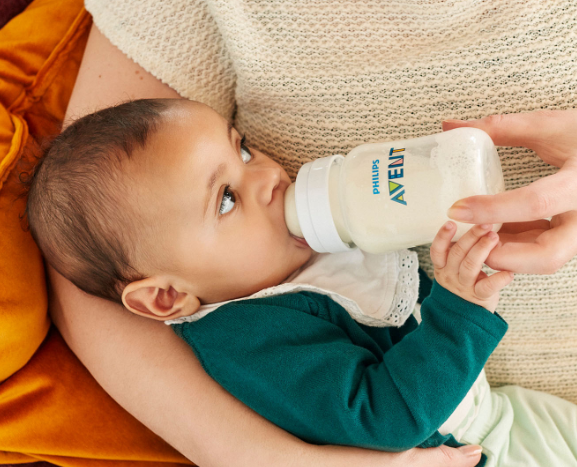
Philips Avent Anti-Colic Baby Bottle
With a textured teat for a more secure latch and help prevent collapsing in the middle of feeding.
The Philips Avent Anti-Colic baby bottle is easy to assemble, with a wide neck and rounded corner for trouble-free cleaning. It also has a leak-free design, so you won’t have to deal with your baby fussing over a sticky milk feel.
The anti-colic valve and bottle prevent your baby’s tummy issues by reducing the amount of air that they can swallow, resulting in less tummy discomfort. This works as the valve attached to the teat flexes, allowing air inside the bottle to prevent vacuum build-up. The air is then let out at the back of the flask, thus, avoiding gas swallowing up during feeding.
The ribbed texture on the teat prevents it from collapsing for uninterrupted feeding, with the shape allowing for a very secure latch. Most of all, you feel at ease knowing that all parts of this bottle are BPA-free, which means none of the pieces are toxic.
Cons: Some reported to have received fast-flowing units despite ordering slower flows, hence; a bit of a hassle when feeding younger infants.
7. Best in Durability — Dr. Brown’s Natural Flow Bottle
Dr. Brown’s Natural Flow Bottle
Take durability to the next level with this nicely curved glass bottle adaptable for both hot and cold milk.
Dr. Brown’s Natural Flow Bottle is one durable feeding bottle made from high-quality glass. In fact, it’s so durable that it can withstand impact when accidentally dropped to a hardwood floor.
With a nicely curved bottle, it is very easy for babies to hold. And if you’re worried about nipple confusion, it won’t be an issue as it is very much adaptable to mixed feeding since it somewhat resembles the feel of breastfeeding.
It is also ideal for both hot and cold temperatures. Because of this, you shouldn’t have any problem using this bottle as breastmilk storage in the freezer after pumping, as well as for a bottle warmer.
The 100% medical-grade silicone makes it very safe to use for babies. The internal vent system prevents the creation of air bubbles and bottle vacuum, preventing colic episodes.
Cons: A bit tedious to clean because of the several parts. Assembly or putting them back together may also be a bit complicated and can result in leaks when not correctly done.
8. Best Squeezable Bottle — Boon NURSH Silicone Bottles
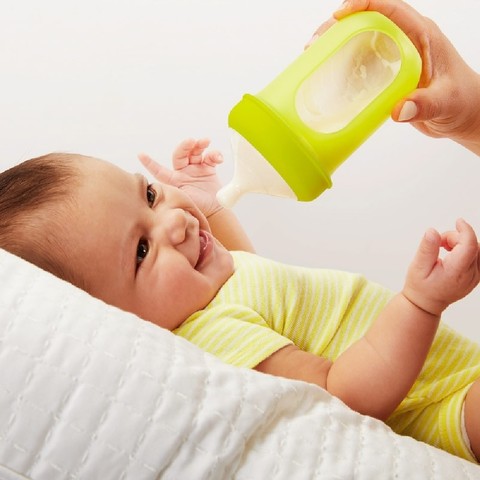
Boon NURSH Silicone Bottles
A squeezable bottle that collapses whenever your baby drinks, protecting your little one against air swallowing problems.
If you are up for some not-so-ordinary looking feeding bottle, then this Boon NURSH Silicone Bottles is perfect. It has a teat shaped like a mother’s with a length made for a perfect latch.
This squeezable silicone pouch collapses every time your baby sips. This, in turn, pushes out the gas-inducing air, which is the main culprit behind colic. As a protection for the squishy bottle, it has an outer shell made of plastic that also acts as its base.
What’s good is that it doesn’t have any straws, valves, or vents, which make it easier to clean than other vented bottles. The line markers are also very prominent for convenience when measuring milk.
Despite its soft texture, you can treat it like any other feeding bottle that you can sterilise, boil, microwave, or even freeze.
The Boon NURSH Silicone Bottles are suitable for babies three months and up with medium flow teats.
Cons: The teat is a bit stiffer than some feeding bottles, but this helps in preventing it from collapsing.
9. Best for Latching — Evenflo Feeding Balance Bottles
Evenflo Feeding Balance Bottles
Give your baby the best latching position during feeding without having to exert too much effort through this specially angled bottle.
Tired of the conventionally-shaped feeding bottle and wanted to be experimental, try this Evenflo Feeding Balance Bottles. It is specifically made to be angled to promote a semi-upright feeding position. This shape aids in the reduction of gas that potentially causes colic, reflux, and even earaches.
It features the brand’s patented Proflo Venting Technology. This ensures that the bubbles just stay within the bottle and are not swallowed by your little one for fuss-free feeding.
Because of its shape, it’s easy for your baby to hold them without too much effort to lift, thus, not invoking some irritation or fussiness in the process. Their arms don’t get tired, so they get to drink more milk in the process.
Since this is just a three-piece assembly, cleaning is as easy as you can get, unlike those with an extra vent system if you can’t be bothered with cleaning spare parts because your little one is more than a handful already. It is also dishwasher safe but be sure to use only the top rack.
This bottle and all its parts are 100% BPA, polycarbonates, PVC, and phthalates-free.
Cons: Some complained about the very slow flow of the teat; hence, babies fall asleep with the milk only half consumed.
10. Best Slim Bottle — Pigeon Flexible
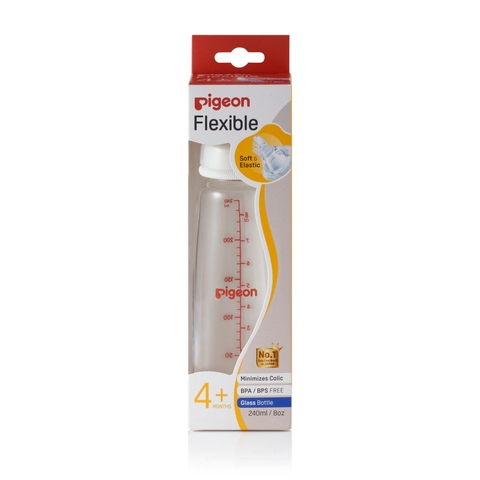
Pigeon Flexible
A high-quality slim bottle that makes latching uncomplicated and reduces stomach issues.
The Pigeon Flexible is one of the brand’s slimline bottles, which are some of their most popular products to date. This is perfect for the slim Flexible Peristaltic Teat that it comes with, which has a double thickness to ensure flexibility when it comes to latching.
It also features a unique venting system to reduce taking in excess gas that causes stomach discomfort and colic.
With materials made from flexible glass that is BPA and BPS-free, no part of the bottle is harmful to your little ones. The bottle is also very transparent and doesn’t discolour when washed.
Though this is a glass bottle, you’ll be surprised that it isn’t as heavy as you would expect. It is also so durable that it can withstand drops and falls. And since it’s slim, it’s easy for your little one to handle.
Cons: Due to the glass materials, you should not expose the bottle to extreme temperature changes.
What to Consider When Buying Bottles For Breastfed Babies
It’s often the case that first-time parents will select bottles for babies before the arrival of their little one. Australia has a lot of options to choose from, and it can sometimes be a case of trial and error to find the right one that your baby prefers. To assist in your research, here are some factors to think about before choosing bottles for breastfed babies.
Choice of Material
Are you after a plastic, glass, silicone or stainless steel baby bottle? All options have pros and cons but either way, the material you choose for your baby bottles should be safe, heat-resistant, and easy to clean. Take note on whether they’re dishwasher and microwave safe and how durable they are if dropped.
Plastic
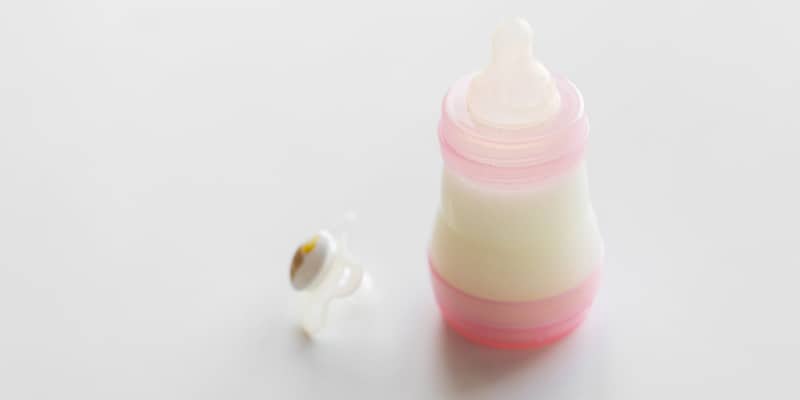
Most baby bottles are made from plastic. Polypropylene is the hard plastic typically used in bottles. It is lightweight and virtually unbreakable but can wear out with frequent use. As they’re generally affordable, they are more practical if you want to have several bottles on hand and won’t weigh your baby bag down too much.
If opting for a plastic bottle, it is important to select a type that is described as BPA free. Bisphenol A (BPA) is used in the manufacturing of many low-quality plastics. This harmful substance has been linked to many health issues, including cancer. It’s worth noting that, although baby bottles in Australia should be BPA free, it’s not actually a legal requirement. Instead, in 2010, there was a “voluntary phase-out” at the request of the Australian government. All of the options in our reviews are BPA free.
It’s also worth noting that the best bottles avoid other harmful chemicals such as:
- Lead
- Phthalate
- PVC
- BPS
It is best to always read the labels and choose a reputable brand. Also, plastic bottles should be replaced often (to be on the safe side), particularly if the plastic starts to show signs of deterioration or becomes cloudy. You may want to toss it out if there are leaks and scratches and keep an eye out on the colour and odour of the bottle and discard accordingly.
Glass
Glass bottles were used long before plastic and are sturdy and long-lasting, but typically more expensive and heavier too. They’re all dishwasher safe and won’t cloud over time as some plastics do. As glass is non-toxic, it doesn’t react with food materials which is great. Therefore, it is naturally BPA free and won’t transmit other aromas into your baby’s milk.

Although glass bottles are usually more expensive than plastic ones, they don’t need to be replaced as often (unless you accidentally break them of course). If handled properly, they’ll last for years and could be repurposed as storage containers for salad dressings or passed on to someone else.
Choose one with silicone sleeves that protect them from breaking and make them easier to hold. Also look for the term, borosilicate glass as this is more forgiving if dropped on hard surfaces.
Silicone
Silicone bottles are naturally free from nasty chemicals such as BPA (and BPS or F), PVC, or Phthalates. Silicone also tends to last longer than plastics and retains heat and cold temperatures for longer.
If you’re after a baby bottle that is non-toxic but isn’t as heavy as glass, silicone baby bottles could be the answer. They’re not as common to find and are more expensive than plastic, but are a lovely product with a softer feel that babies like.
Stainless Steel
Stainless steel bottles are also not as common as plastic (probably as they’re more expensive) and you can’t see inside the bottle to accurately measure the contents.
They are durable and BPA free, plus like glass, they won’t react with baby’s milk.
Other Features — Bottle Design, Volume, Teat Shape
Baby bottles come in various shapes and sizes and it’s important to pick the right one for your baby.
Bottle Designs
The most common shaped bottles are tall and straight as they’re easy to clean and fill.
Bottles that are shaped are generally designed to reduce stomach pain. The bottle is bent below the neck preventing your little one from swallowing air that may cause pain and discomfort. There are also wide neck and regular neck bottles and shorter and longer nipple length to mimic the baby’s mother.
Volume
Small bottles usually hold 150 ml and are suitable for newborns. Once your baby grows, it’s more practical to switch to larger bottles as these will no longer hold enough milk for one feed. Tiny babies cannot hold a bottle that’s too big, so it’s best to start with something they can manage.
Nipple Material, Shape and Teat Flow
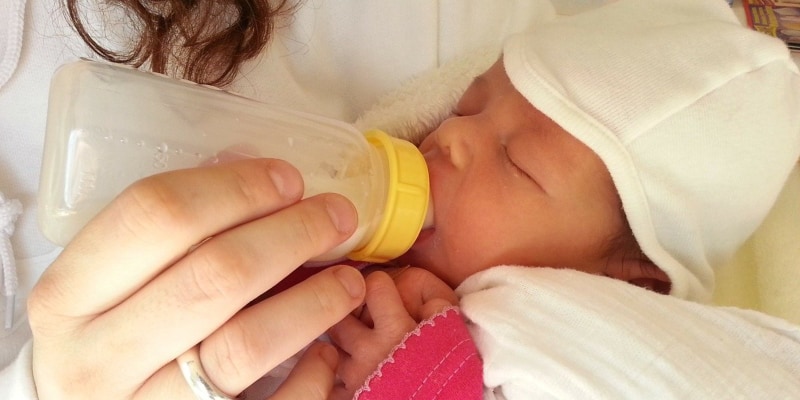
The nipple material needs to be comfortable otherwise a baby will refuse the bottle. They are generally made from silicone and some are latex.
Silicone is man-made and durable and 100% tasteless. It can get damaged if babies bite it with sharp teeth.
Natural, rubber latex is good if you’re specifically after a natural product, but it doesn’t last as long as silicone and can get damaged in the sunlight.
The shape of the nipple is hugely important too as this will affect how your baby attaches. Wide nipples are generally preferred with babies who are just getting started. Likewise, teats that are flat on one side can make babies feel like they’re feeding on the mother who is holding them close to her chest.
Lastly, all teats have different levels of speed referred to as flow. So your baby doesn’t gag, pick the right level of flow based on how fast your baby can swallow. The younger the baby, the slower the flow and newborn babies need to suckle on the lowest level. You can increase the level as the baby grows by simply changing the ‘teat’ for the same bottle.
Accessories / Extra Functions
Besides the main features, we tend to be swayed by extras that come with the bottle. Some of the common accessories offered by different brands are the following:
Venting System
Since the most prevalent issue with bottle feeding is swallowing gas which leads to more complicated problems, vented bottles have become so popular. These aim to eliminate or at least reduce the occurrence of colic and other stomach issues in babies that lead to their fussiness.
Most of these include a valve that looks like straw or tube. However, there are also those that come with disposable liners that work for the same purpose but in a more convenient way, especially when you travel. However, you have to purchase them regularly.
Breast Pump Bottles
Besides the shape and size, you might also want to consider the functionality. Most feeding bottles do the same purpose; to dispense milk for babies. However, some do more than that.
If you’re looking to take convenience to the next level, perhaps a feeding bottle that also works as a breast pump container and freezer-safe storage might be more appealing to you.
Frequently Asked Questions
What are the best bottles for breastfed babies?
The best baby bottles are the ones that your baby prefers to use and are safe from toxins. It is hard to say whether wide necks are better than narrow ones (although wide is good for cleaning purposes). But at the end of the day, it’s all about how your baby attaches to the nipple and has a good feed without issue (such as colic).
Which bottle is best for babies (plastic, glass, silicone, or stainless steel)?
In terms of material, the best baby bottles are ones that suit your little one, your lifestyle, and budget. The one we have at the top of our list (Philips Avent Natural Baby Bottle) is a best selling, top-rated product on Amazon, and we listed it as our ‘best overall’ due to its value for money in terms of price, safety, ease of use and features. All materials have their pros and cons with most parents opting for plastic (that’s BPA free) due to convenience and ease of use plus its lightweight.
When is the right time to transition from breast feeding to bottle feeding?
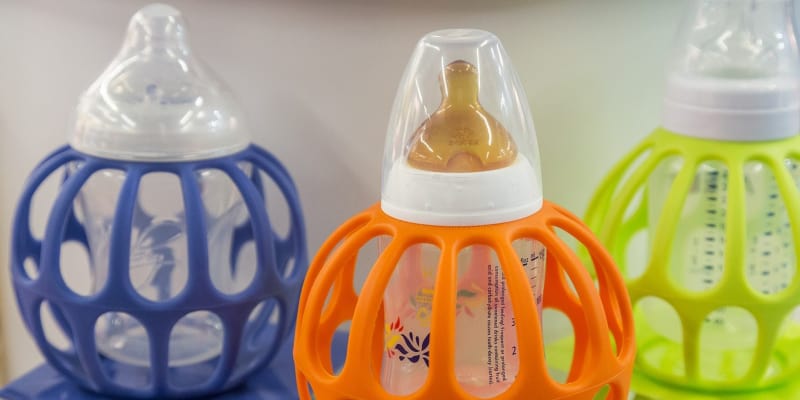
Most lactation experts suggest waiting until your baby is at least one month old before introducing the bottle into your feeding routine. Giving your baby a bottle before this period could mean they develop a preference for the bottle and start to refuse the breast.
It really is a balancing act, and if you wait too long, your baby might refuse the bottle. If you want to successfully mix feed, don’t be discouraged if your baby takes a while to get familiar with the bottle and the formula taste. Sometimes a lot of persistence and patience is needed and all babies respond differently.
Are wide-neck bottles better for breastfed babies?
While wide-neck bottles may work for some babies, others may find it hard to adapt. This is especially so for newborns who have tiny mouths since wide neck feeding bottles tend to also have relatively larger teats.
However, this is not always the case. Some wide neck bottles have really long nipples to compensate for their wide slope that the baby’s mouth can no longer latch on.
The Choice is Yours….
There are so many options on the market and finding the best bottles for your precious bub may take a few attempts. Many parents start with a couple of different brands (if your budget can allow for this) or a starter pack to test out what one works best for your baby.
Lastly, when your little one graduates from bottles to sippy cups, we have colour changing glass bottles and sippy cup recommendations for your convenience.