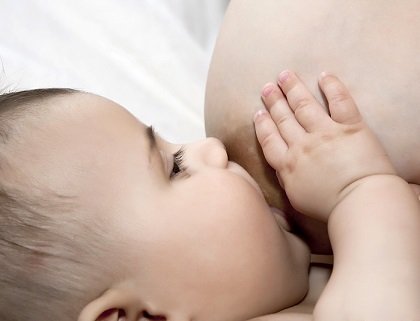
Breastfeeding: The best start for your baby

Birth and breastfeeding are physiologically intertwined, as the same hormones are integral to their process and success. As baby is born and placed in contact with the mother’s body a surge of oxytocin (the hormone of love, birth and breastfeeding) occurs in the mother causing uterine contractions and expulsion of baby’s placenta. These strong contractions also help reduce blood loss immediately after the birth.
As a mother holds her newborn baby against her skin their intimate relationship begins. Skin to skin contact with baby laid on mother’s bare chest is the natural protective ‘habitat’ of the newborn baby, and this positioning switches on baby’s brain-waves to instinctively search for the breast.
A newborn baby placed skin-to-skin with mother instinctively seeks the breast, latches and suckles nutritively shortly after birth. Breastmilk is a living fluid with all the nutrients baby needs, and is far superior to artificial baby milk formula. The first breastmilk (colostrum) is richer than mature milk, provides immunity from infections, and is available from birth at exactly the right temperature, volume and digestibility.
Healthy babies have an inborn ability to seek the breast and should not be hurried when making the transition from womb to breast. This first encounter between mother and baby is profound and significant. The environment required to enhance and facilitate this process is the same as for birth – private and warm, with a sense of safety for the family. This environment enhances the mother’s response and confidence to nurture her baby. Interventions and interruptions (including excited mobile phone calls and messages) can derail the baby’s innate responses. The mother-baby chemistry is easily disturbed. Drugs used during labour can adversely affect the responses of both mother and baby.
Baby’s instincts to seek the breast and to latch-on are intense in the hour after birth, and successful transfer of colostrum and comfort imprints baby to repeat this biologically driven behaviour. Immediately after birth the baby has a surge of adrenaline and noradrenaline, which makes baby very alert in the hour after birth. This alert state is also stressful however skin to skin contact counteracts the stress and calms baby. Mother’s touch, body warmth, scent and voice calm baby, and both are focussed on one another as they gaze into each other’s eyes.
Baby’s touch by mouth and hands on the mother’s chest stimulate oxytocin release enhancing mother’s feelings of attachment and stimulating her milk ejection reflex (letdown). Baby also releases oxytocin during this quiet alert state which triggers feeding behaviours known as the ‘breast crawl’.
Baby begins the search by lifting his head, bobbing and stroking his face and cheeks on mother’s skin, and with upper body movements and perhaps crawling motions of his legs and feet, he begins wriggling purposefully towards a breast. The mother instinctively gives baby gentle support of his body but allows the head to be free to move. When baby’s chin comes in contact with the breast tissue under the nipple, baby will gape the mouth widely with the tongue down and forward, and “launch and latch” to the breast.
The suckling action sets baby’s gastrointestinal system in motion and the laxative effect of the colostrum assists passing of black meconium (poo). The colostrum is rich with immunological components which protect baby from pathogens, and skin to skin contact with the mother colonises baby with her skin flora providing further protection from the new environment.
Most mothers in Australia offer their newborn babies breastfeeds in the early days of life. Babies do best if they are cuddled frequently in skin to skin contact which will enhance the baby’s instinctive responses and the mother’s breastfeeding skill development.
Beginning each breastfeed with a breast crawl will ensure baby’s natural feeding reflexes are ‘switched on’. Mother can help baby to attach to the breast however she finds works best for her baby and her own comfortable breastfeeding experience. Baby determines how often feeds occur and their duration, and the mother’s breasts respond with gradually increasing volumes of colostrum and production of transitional milk 2-6 days after the birth.
Many new mothers leave hospital within a few days of giving birth, before their “milk has come in” and breastfeeding is established. Breastfeeding is a new skill which takes time for mothers to master. New parents have a steep learning curve and need understanding and support as they adjust to their new life as a family. Modern women may doubt their capacity to completely nurture their child but scientific discoveries continue to confirm the wondrous properties and unique benefits of human breast milk from newborn to toddlerhood and beyond.
Article written by Lois Wattis. Lois Wattis is a Registered Nurse/Midwife, International Board Certified Lactation Consultant and Fellow of the Australian College of Midwives. Her expertise has now been shared via New Baby 101- A Midwife’s Guide for New Parents App and eBook which includes 5 videos. Find out more about the book here