Toddler Sleep Solutions

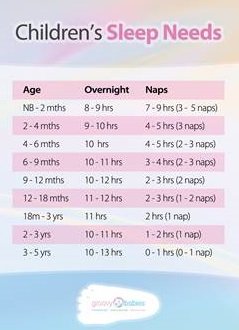
On average toddlers need about 12-14 hours of sleep in a 24-hour period. When they reach about 18 months of age their naptimes will decrease to once a day lasting about one to three hours. On average the awake time of a child this age can be 3-4 hours for a 12-18 months on a 2 nap day, 4.5-6 hrs on a 1 nap a day. For 18-24 months 5-6 hours up before a daily nap and 2-3 years 5.5 – 7 hours before a nap. Recommendation 4 hours for bedtime after the end of the last nap.
Many toddlers experience sleep problems including resisting going to bed and night time awakenings. Night time fears and nightmares are also common. Many factors can lead to sleep problems. Toddlers’ drive for independence and an increase in their motor, cognitive and social abilities can interfere with sleep. In addition, their ability to get out of bed, separation anxiety, the need for autonomy and the development of the child’s imagination can lead to sleep problems. Daytime sleepiness and behaviour problems may signal poor sleep or a sleep problem. Such problems with settling to sleep are common in young children, affecting 20% of 1- to 3-year-olds and 10% of 4½-year-olds.
Help your toddler sleep better by effective bedtime management focused on establishing a regular sleep schedule, an appropriate sleep environment, and consistent limit-setting for dealing with bedtime struggles. Emotional Wellbeing the primary aspect of focus.
Chronically over tired children may not seem tired, and don’t always act tired. They will always resist sleep and need us to help them form good sleep habits.
Signs of over tired toddlers are:
- tend to be whiny, fussy or clingy
- sucks thumb, finger, or wants to suckle other than at bedtimes.
- carries blanket, stuffed toy around during the day.
- is hyperactive, especially at times when you think they should be tired.
- is overly stubborn.
- has regular temper tantrums, or easily becomes upset or angry.
- has difficulty falling asleep when put to bed
- falls asleep frequently when in car, bus or train.
- falls asleep in front of TV
- sometimes falls asleep on the couch or floor before bedtime.
- takes a long time to become alert and awake in the morning.
- does not appear to be well rested and full of energy.
- doesn’t seem as happy as she should be.
Key Points to help your toddler slip into sleep.
- Maintain a daily sleep schedule and consistent bedtime routine.
- Make the bedroom environment the same every night and throughout the night.
- Set limits that are consistent, communicated and enforced. Encourage use of his favourite stuffed toy or comforter.
Bed Time Routines
All children need a comforting bedtime routine, and they need it from early infancy right up through the school years. It gives them a healthy sense of predictability and it’s a wonderful opportunity for parents and children to slow down and reconnect peacefully at the end of the day.
- Give your toddler choices before bed like which pjs does he/she want to wear, which book may he/she want to read or what extra toy (quiet), he/ she might want to take to bed. It will make him/her feel in control and make him/her less likely to resist when it’s time for lights out. Think about creating your own unique bedtime ritual which you will share for years come: a special song, sharing two things you liked about your day, reading out loud, prayers, blessings or sending kisses and love to others.
- Done right, bedtime can be a special, loving time to celebrate closeness; a time your child will look forward to and cherish. If two parents take turns at bedtime, they don’t have to follow an identical script but should have a similar routine, style and response to any bedtime power plays, fears or stalling.
- A soothing bedtime routine signals the body and brain to slow down and prepare for sleep. The tone of bedtime should be calm, quiet and reassuring as you prepare your kid to separate from you all night.
It is important to remember that every child is an individual and it’s important to listen to the cues that your toddler is giving you. What may have worked for your friend/sister/neighbour doesn’t necessarily work for another. Clear rules and parental consistency is essential for transitioning sleep situations…mixed liberally with plenty of love, cuddles, and kisses!
And MOST importantly be wary that your expectations are that of an adult not as a 12, 15, 18 or 24 month old.
What are the similarities and differences amongst the variety of sleep approaches and methods?
Similarities
All aim to help families.
All aim to educate parent’s on what their baby needs to go to sleep or return to sleep upon waking.
All aim to educate parents on sleep patterns.
Gentle sleep approach combines no-cry and periods of crying to teach gentle independence.
Differences
No cry methods believe that leaving a baby to cry creates a negative sleep association which maybe detrimental to the child’s emotional health. Crying is acknowledged as the baby’s primary way of communication. The methods work to combine many tools (nursing, rocking, co-sleeping, responding to crying, altering feeding/sleeping patterns) to improve sleep patterns.
Extinction believes that by allowing a child to cry indefinitely at bedtime and up to 1 hour at nap time, the child learns quickly to fall asleep and return to sleep unassisted. Argues that the consequences of poor sleep habits and inadequate sleep far out way the short term emotional health the child experiences whilst undergoing this type of method.
Controlled Crying or Ferberization: parents respond in increments of time to child’s cries, in limited duration.
Parent led approach: parents set the daily agenda or specific time table of sleep, feeding and playing.
Baby led approach: feed, play sleep is parent’s following the baby’s cues of natural schedule.
So here are some guidelines that I suggest a family considers in regards to choosing a sleep solution:
-what sleep approach is best suited for you and your child and family?
– write down what methods you know, read and have tried.
-write down what you know works for their baby.
-write down what you know does not work for their baby.
– take into consideration age of your baby.
-take into consideration if you are breastfeeding or bottling feeding.
– Write down if you wish for a parent led approach or baby led approach- be honest.
– Write down if you feel more comfortable with a no-cry, cry or combination of both methods.
– write down the length of time YOU and YOUR PARTNER have been sleep deprived, thus time they are prepared to commit to change.
– are you returning to work.
-are there are any health concerns to be considered, e.g. reflux, prematurity, snoring. Allergies, twins, PND mother/father to begin with…..
This article provided by Amanda Bude. Amanda is an expert Advanced Maternity and Child Sleep Consultant based on Gold Coast, whose business Groovy Babies provides Gentle Sleep Solutions Australia Wide, for families from pregnancy through to age 5. She is also an experienced Antenatal, Birth Suite and Postnatal Midwife of 17 years, HypnoBirthing® -The Mongan Method Childbirth Educator and Certified Infant Massage Instructor. Amanda proudly is the FIRST Australian and Midwife to study and become a Certified Maternity, Baby and Child Sleep and Settling Consultant. She is also a mum to 7 year old Amelia, and 6 year old twins Josh and Bree.
For further information or help please email at [email protected].